

Of all the traits the human genome can produce, few are as visually arresting or as scientifically fascinating as hazel eyes. Unlike the relatively straightforward genetics of brown or blue eyes, hazel eyes emerge from a layered interplay of pigmentation, light physics, and multiple genes working in concert. The result is an eye color that doesn’t sit still: it shifts, deepens, and glows differently depending on where you’re standing and what you’re wearing.
This isn’t magic. It’s biology. And it’s worth understanding.
What Makes Hazel Eyes Unique?
Most eye colors can be reduced to a single dominant trait: a high concentration of melanin producing brown eyes, or an absence of it yielding blue. Hazel eyes follow neither rule. Instead, they display a mosaic of brown, green, and amber tones within the same iris, often arranged in concentric rings or irregular patches that make each pair entirely one-of-a-kind.
The key lies in melanin distribution. In brown eyes, melanin is dense and evenly spread across the iris. In blue eyes, it’s sparse. In hazel eyes, melanin is present in moderate but uneven amounts concentrated in some areas, thin in others. This uneven layering means that different parts of the iris interact with light differently, scattering certain wavelengths and absorbing others. The color you perceive depends on which part of the iris catches the light at any given moment.
The Genetics Behind Hazel Eyes
Hazel eyes are what geneticists call a polygenic trait; they’re shaped not by one gene, but by the coordinated activity of several. This complexity is precisely why hazel eyes are so variable, and why two siblings can both have “hazel” eyes that look nothing alike.
OCA2 is perhaps the most important player. This gene governs the production of melanin in the iris. When OCA2 is highly active, brown eyes result. When it’s less active, lighter colors emerge. In hazel eyes, OCA2 activity falls in an intermediate range of melanin to prevent blue or grey tones, but not enough for solid brown. Crucially, its activity can vary across different regions of the same iris, which is what produces the characteristic color variation within hazel eyes.
HERC2 acts as a regulatory switch for OCA2. Rather than producing melanin itself, HERC2 controls when and where OCA2 is expressed. Variations in HERC2 can create patchy melanin distribution, which directly contributes to the brown-green-gold patchwork typical of hazel irises.
Then there are supporting genes — TYR, TYRP1, and IRF4 — that influence how melanin is synthesized and processed at the cellular level. Subtle variations in these genes can tip hazel eyes toward green, or anchor them firmly in warm amber-brown territory. This is why hazel eyes show more internal diversity than virtually any other eye color: there are simply more genetic variables in play.
How Light Shapes What You See
Genetics sets the stage, but light determines the performance. Hazel eyes are uniquely sensitive to their environment, and the same pair of eyes can look markedly different from one hour to the next.
This happens because the iris has multiple layers, each with its own melanin density. When light enters the eye, it bounces between these layers before reflecting back out. Short wavelengths (blue-green light) scatter more easily; longer wavelengths (amber-red) tend to be absorbed. Depending on the angle, intensity, and color temperature of the light source, different wavelengths dominate the reflected output changing the perceived color of the eye.
Pupil size adds another dimension. A dilated pupil exposes more of the iris’s outer ring, which often contains less melanin and therefore appears lighter or greener. A constricted pupil draws attention to the darker, melanin-rich area around the pupil itself.
Here’s how different conditions tend to affect hazel eyes:
| Condition | Effect on Hazel Eyes |
| Bright sunlight | Brings out gold and amber tones |
| Fluorescent indoor light | Emphasizes green or flat brown |
| Warm incandescent light | Enriches brown and honey hues |
| Open outdoor shade | Often reveals the most green |
| Wearing green clothing | Intensifies green tones in the iris |
| Wearing brown or gold tones | Deepens the amber and brown |
| Dilated pupil | More color variation visible across the iris |
| Constricted pupil | Colors appear more concentrated and defined |
The Different Types of Hazel Eyes
“Hazel” is a broad category. Within it, there are seven distinct variations, each shaped by a different balance of the underlying genetics and each visually unlike the others.

Copper-hazel is one of the most striking and least discussed variations. The iris carries a warm, reddish-brown base threaded with gold and subtle green, producing a burnished, almost metallic quality. This tone arises when pheomelanin, the same pigment responsible for red hair, dominates over eumelanin in the iris, giving the eye a rare, luminous depth that reads differently under every light source.
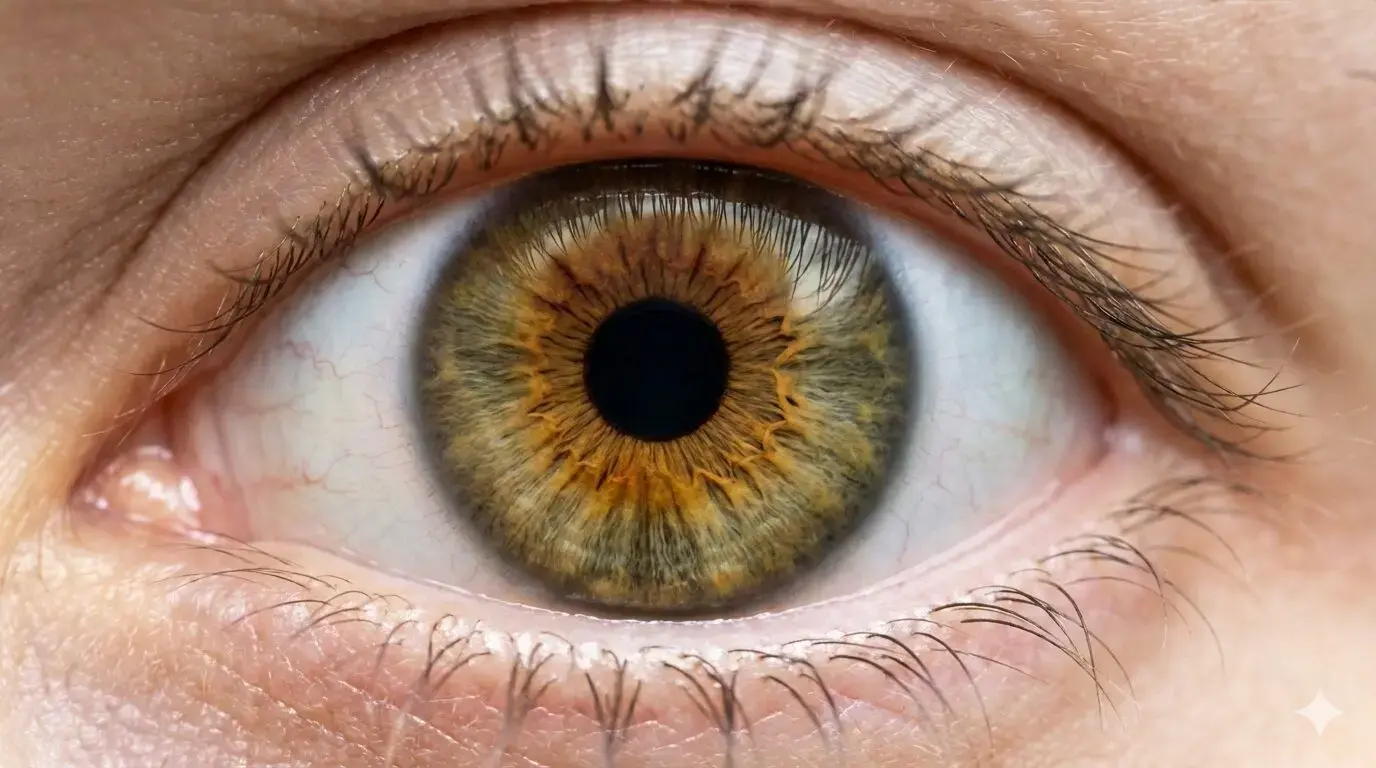
Sunburst hazel is defined not just by its colors but by its architecture. A dark brown or near-black ring encircles the pupil tightly, then radiates outward in vivid gold before transitioning to green at the outer iris edge. This starburst pattern is structurally caused by radial melanin deposits making it one of the most visually dramatic hazel variations.

Olive hazel occupies the cool, earthy end of the hazel spectrum. Neither warm nor particularly vibrant, it blends muted khaki green with dusky brown to produce a tone reminiscent of aged olive wood or deep forest moss. Its sophistication lies in its restraint, a complex color that rewards close attention.

Stormy hazel is the coolest variation in the family. Grey and green dominate, with dark brown undertones swirling beneath in a way that evokes overcast skies or deep water. Unlike blue-hazel, which reads as icy and translucent, stormy hazel has weight and turbulence to it a moodier, more unsettled quality.

Honey-hazel sits at the lighter, warmer end of the spectrum. Its base is a translucent golden-brown, with soft green and amber undertones that seem to glow from within particularly in sunlight, where the iris can appear almost backlit. The effect is warm and luminous, closer in feeling to light passing through amber glass than to any conventional eye color description.

Blue-hazel, sometimes called grey-hazel, is perhaps the rarest structural variation. A cool grey-blue base characteristic of low melanin is scattered with warm hazel brown and muted green flecks distributed unevenly across the iris. The result is a striking tension between cool and warm tones occupying the same space, producing an eye color that reads entirely differently depending on the light and the distance from which it’s observed.

Amber-green hazel is the final variation and one of the most jewel-like. Rich warm amber and vivid green appear in roughly equal patches, with no significant brown presence to anchor either tone. The two colors meet in organic, irregular boundaries across the iris, creating an effect that is less earth-toned than most hazel variations and more reminiscent of a precious stone tourmaline, perhaps, or a piece of Baltic amber held up to sunlight.
Rarity and Global Distribution
Hazel eyes are relatively uncommon worldwide, found most frequently in people of European descent, though they appear across many ethnic backgrounds. Their rarity is a direct consequence of the genetic complexity required to produce them: the precise combination of gene variants that creates moderate, uneven melanin distribution is less likely to occur than the combinations that produce consistently high or low melanin.
Among the seven variations, blue-hazel and amber-green hazel sit at the rarest end of the spectrum, requiring an unusually precise genetic combination to produce. In regions where brown eyes dominate, which is most of the world, any lighter eye color attracts attention, but the multicolored, shifting nature of hazel eyes in any of its forms tends to draw a particular kind of fascination that solid eye colors simply don’t generate.
Why No Two Hazel Eyes Are Alike
It bears emphasising: the genetic architecture behind hazel eyes is complex enough that no two people, not even identical twins will have hazel irises that look exactly the same. The number of genes involved, the range of expression levels each can take, and the sensitivity of the outcome to slight variations in melanin distribution all combine to make hazel eyes extraordinarily individualised.
This is part of what makes them so enduringly fascinating. They are not a fixed color but a dynamic system, a biological structure calibrated to interact with the world around it in ways that simpler pigmentation patterns simply cannot.
Final Thoughts
Hazel eyes are a window into the complexity of human genetics. They arise not from one clear genetic signal, but from the layered, probabilistic interaction of multiple genes governing a single biological trait. That complexity produces variation in color, in pattern, in how each pair responds to its environment.
Understanding the science doesn’t diminish the beauty of hazel eyes. If anything, it deepens it. What appears as a mysterious, shifting quality is in fact a precise if extraordinarily complicated biological outcome. Nature, in this case, made something rare and intricate seem effortless.